Connexion


Le Bret
Si tu laissais un peu ton âme mousquetaire
La fortune et la gloire…
Cyrano
Et que faudrait-il faire ?
Chercher un protecteur puissant, prendre un patron,
Et comme un lierre obscur qui circonvient un tronc
Et s’en fait un tuteur en lui léchant l’écorce,
Grimper par ruse au lieu de s’élever par force ?
Non, merci. Dédier, comme tous ils le font,
Des vers aux financiers ? Se changer en bouffon
Dans l’espoir vil de voir, aux lèvres d’un ministre,
Naître un sourire, enfin, qui ne soit pas sinistre ?
Non, merci. Déjeuner, chaque jour, d’un crapaud ?
Avoir un ventre usé par la marche ? Une peau
Qui plus vite, à l’endroit des genoux, devient sale ?
Exécuter des tours de souplesse dorsale ?…
Non, merci. D’une main flatter la chèvre au cou
Cependant que, de l’autre, on arrose le chou,
Et donneur de séné par désir de rhubarbe,
Avoir un encensoir, toujours, dans quelque barbe ?
Non, merci ! Se pousser de giron en giron,
Devenir un petit grand homme dans un rond,
Et naviguer, avec des madrigaux pour rames,
Et dans ses voiles des soupirs de vieilles dames ?
Non, merci ! Chez le bon éditeur de Sercy
Faire éditer ses vers en payant ? Non, merci !
S’aller faire nommer pape par les conciles
Que dans les cabarets tiennent des imbéciles ?
Non, merci ! Travailler à se construire un nom
Sur un sonnet, au lieu d’en faire d’autres ? Non,
Merci ! Ne découvrir du talent qu’aux mazettes ?
Être terrorisé par de vagues gazettes,
Et se dire sans cesse : « Oh, pourvu que je sois
Dans les petits papiers du Mercure François ? »…
Non, merci ! Calculer, avoir peur, être blême,
Préférer faire une visite qu’un poème,
Rédiger des placets, se faire présenter ?
Non, merci ! non, merci ! non, merci ! Mais… chanter,
Rêver, rire, passer, être seul, être libre,
Avoir l’œil qui regarde bien, la voix qui vibre,
Mettre, quand il vous plaît, son feutre de travers,
Pour un oui, pour un non, se battre, – ou faire un vers !
Travailler sans souci de gloire ou de fortune,
À tel voyage, auquel on pense, dans la lune !
N’écrire jamais rien qui de soi ne sortît,
Et modeste d’ailleurs, se dire : mon petit,
Sois satisfait des fleurs, des fruits, même des feuilles,
Si c’est dans ton jardin à toi que tu les cueilles !
Puis, s’il advient d’un peu triompher, par hasard,
Ne pas être obligé d’en rien rendre à César,
Vis-à-vis de soi-même en garder le mérite,
Bref, dédaignant d’être le lierre parasite,
Lors même qu’on n’est pas le chêne ou le tilleul,
Ne pas monter bien haut, peut-être, mais tout seul !
Denis Lavant, pour son seul-en-scène, “Le Sourire au pied de l’échelle”, d’après un texte de Henry Miller, au Théâtre de l’Œuvre. Le récit de la crise existentielle d’un clown qui visait la lune, et qui ne voulait plus faire rire les gens, mais leur apporter de la joie.
https://www.franceculture.fr/emissions/la-grande-table-1ere-partie/denis-lavant-fait-le-clown
Croyance à l’inspiration. Les artistes ont quelque intérêt à ce qu’on croie à leurs intuitions subites, à leurs prétendues inspirations ; comme si l’idée de l’oeuvre d’art, du poème, la pensée fondamentale d’une philosophie tombaient du ciel tel un rayon de la grâce. En vérité, l’imagination du bon artiste, ou penseur, ne cesse pas de produire, du bon, du médiocre et du mauvais, mais son jugement, extrêmement aiguisé et exercé, rejette, choisit, combine ; on voit ainsi aujourd’hui, par les Carnets de Beethoven, qu’il a composé ses plus magnifiques mélodies petit à petit, les tirant pour ainsi dire d’esquisses multiples. Quant à celui est moins sévère dans son choix et s’en remet volontiers à sa mémoire reproductrice, il pourra le cas échéant devenir un grand improvisateur ; mais c’est un bas niveau que celui de l’improvisation artistique au regard de l’idée choisie avec peine et sérieux pour une oeuvre. Tous les grands hommes étaient de grands travailleurs, infatigables quand il s’agissait d’inventer, mais aussi de rejeter, de trier, de remanier, d’arranger.
Nietzsche, Humain, trop humain, §. 155
[Je réponds à votre question] pour lier l’art de l’acteur, qui est l’idée, on pourrait dire “théâtralement correcte” comme on dit “politiquement correct”, à une chose qui l’est moins, qui est le fait de déballer son intimité sur le plateau, qui est, pourtant, essentielle.
Philippe Caubère, Comment se fait votre travail d’improvisation ?
“If we shadows have offended,
Think but this, and all is mended,
That you have but slumber’d here
While these visions did appear.
And this weak and idle theme,
No more yielding but a dream,
Gentles, do not reprehend:
if you pardon, we will mend:
And, as I am an honest Puck,
If we have unearned luck
Now to ’scape the serpent’s tongue,
We will make amends ere long;
Else the Puck a liar call;
So, good night unto you all.
Give me your hands, if we be friends,
And Robin shall restore amends.”
- William Shakespeare, A Midsummer Night’s Dream
Ombres que nous sommes, si nous avons déplu, — figurez-vous seulement (et tout sera réparé) — que vous n’avez fait qu’un somme, — pendant que ces visions vous apparaissaient. — Ce thème faible et vain, qui ne contient pas plus qu’un songe, — gentils spectateurs, ne le condamnez pas ; — nous ferons mieux, si vous pardonnez. Oui, foi d’honnête Puck, — si nous avons la chance imméritée — d’échapper aujourd’hui au sifflet du serpent, — nous ferons mieux avant longtemps, — ou tenez Puck pour un menteur. — Sur ce, bonsoir, vous tous. — Donnez-moi toutes vos mains, si nous sommes amis, — et Robin prouvera sa reconnaissance.
Vu à la Comédie Française le 26 avril 2014, mise en scène Muriel Mayette-Holtz
The audience should go out front and you should go onstage as if to a hot date, not as if to give blood. No one wants to pay good money and irreplaceable time to watch you be responsible. They want to watch you be exciting. And you can’t be exciting if you’re not excited; and you can’t be excited if you’re thinking about nothing more compelling than your boring old concentration, self-performance, and good ideas.
David Mamet, True and False
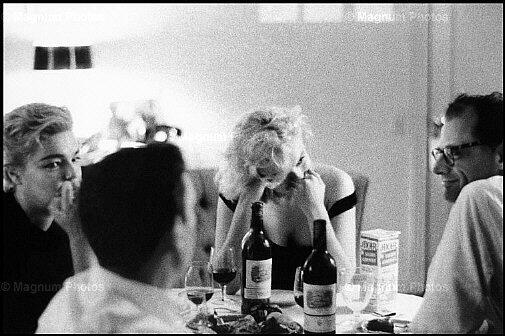
Party Endowments dans la vraie vie…
Via Brain Magazine
A villain must be a thing of power, handled with delicacy and grace. He must be wicked enough to excite our aversion, strong enough to arouse our fear, human enough to awaken some transient gleam of sympathy. We must triumph in his downfall, yet not barbarously nor with contempt, and the close of his career must be in harmony with all its previous development.
Agnes Repplier
“The one thing you always have to have in your playing is hope. When you lose hope and you think to yourself, ‘ugh, what am I going to do with this?’ you’re not going to do anything …because you’ve already projected yourself, and I [the listener] have heard it and can tell you’re not committed…”
[Talking to a keyboard player about his lead into a break:] “You thought to yourself ‘I should have left a space.’ I could feel you thinking that. But it’s too late; now you’re in that space. The beauty of jazz is that we’re in that moment. What happens in that moment is it’s a moment of absolute clarity because you’re there now. When we jump off a building we can’t jump back up. We’re either gonna fly or grab something. Okay, grab something or fly.
[On silence:] “The one thing I want you to notice is after an event, wait. Why do you wait? Because the emotion is in the silence. I come over to you and I talk to you; I want to tell you something. I put my hand on you, I say, ‘Man, that was a beautiful phrase you played.’ When I stop talking to you then you feel the emotion of it and that’s when you assess how you gonna accept what I tell you. In that moment you feel something, but if I [talk] past that moment, if I say ‘I love the way you play [and] you know, you ought to think about that reed you’re using,’ I’ve lost something.”
Wynton Marsellis
Via Joe Bill, Michael Robinson, Dan O’Connor.
Dear Mr. Howe,
Your letter comes out of the blue and puts me on the spot. You ask how to become a director. […] You become a Director by calling yourself a Director and you then persuade other people that this is true. […] The Energy produced by working is more important than anything else!
Peter Brook, The Shifting Point (1988)
Cher M. Howe,
Votre lettre me prend au dépourvu et me met dans une situation difficile. Vous demandez comment devenir un metteur en scène. […] Vous devenez un Metteur en Scène en vous appelant vous-même Metteur en Scène et ensuite en persuadant d’autres personnes que cela est vrai. […] L’Énergie produite par [votre] travail est plus importante que tout le reste !
Via La Boite à Impro
Well, you make games that have all the trappings of a blockbuster — in term of sparkle, budget, and scope — but if you look at all closely, you realize that what you’re doing is actually quite strange and conceptually audacious. It’s sort of like what Terrence Malick does, only video-game-ized. That’s a risky line to walk. Are you conscious of that?
Objectively, what I do is strange, in the sense that if you looked at it and wrote a description of it — the themes and the setting and the time period — it would come across as rather strange. But probably no stranger than a lot of games. Assassin’s Creed is really strange in its own way. Games generally are strange, let alone all the indie games, which are really strange.
Games are strange because we don’t know what the form is yet. We’re just figuring that out as we go along. Games are strange because we don’t know what the form is yet. We’re just figuring that out as we go along. So we have only strangeness, to some degree.
Ken Levine, à propos de Bioshock Infinite
“The best stories are about ‘One plus one equals three’.”
“We all think that an exception is going to be made in our case and we’re going to live forever. Being a human is actually arriving at the understanding that that’s not going to be. Story is there to remind us that it’s just OK.”
Via : http://www.presentationzen.com/presentationzen/2012/07/ken-burns-on-the-power-of-story.html
I feel that this award was not made to me as a man, but to my work — a life’s work in the agony and sweat of the human spirit, not for glory and least of all for profit, but to create out of the materials of the human spirit something which did not exist before. So this award is only mine in trust. It will not be difficult to find a dedication for the money part of it commensurate with the purpose and significance of its origin. But I would like to do the same with the acclaim too, by using this moment as a pinnacle from which I might be listened to by the young men and women already dedicated to the same anguish and travail, among whom is already that one who will some day stand here where I am standing.
Our tragedy today is a general and universal physical fear so long sustained by now that we can even bear it. There are no longer problems of the spirit. There is only the question: When will I be blown up? Because of this, the young man or woman writing today has forgotten the problems of the human heart in conflict with itself which alone can make good writing because only that is worth writing about, worth the agony and the sweat.
He must learn them again. He must teach himself that the basest of all things is to be afraid; and, teaching himself that, forget it forever, leaving no room in his workshop for anything but the old verities and truths of the heart, the old universal truths lacking which any story is ephemeral and doomed - love and honor and pity and pride and compassion and sacrifice. Until he does so, he labors under a curse. He writes not of love but of lust, of defeats in which nobody loses anything of value, of victories without hope and, worst of all, without pity or compassion. His griefs grieve on no universal bones, leaving no scars. He writes not of the heart but of the glands.
Until he relearns these things, he will write as though he stood among and watched the end of man. I decline to accept the end of man. It is easy enough to say that man is immortal simply because he will endure: that when the last ding-dong of doom has clanged and faded from the last worthless rock hanging tideless in the last red and dying evening, that even then there will still be one more sound: that of his puny inexhaustible voice, still talking. I refuse to accept this. I believe that man will not merely endure: he will prevail. He is immortal, not because he alone among creatures has an inexhaustible voice, but because he has a soul, a spirit capable of compassion and sacrifice and endurance. The poet’s, the writer’s, duty is to write about these things. It is his privilege to help man endure by lifting his heart, by reminding him of the courage and honor and hope and pride and compassion and pity and sacrifice which have been the glory of his past. The poet’s voice need not merely be the record of man, it can be one of the props, the pillars to help him endure and prevail.
William Faulkner’s Nobel Prize Speech - Stockholm, December 10, 1950
http://www.mcsr.olemiss.edu/~egjbp/faulkner/lib_nobel.html
We are the music makers,
And we are the dreamers of dreams,
Wandering by lone sea-breakers,
And sitting by desolate streams;—
World-losers and world-forsakers,
On whom the pale moon gleams:
Yet we are the movers and shakers
Of the world for ever, it seems.
Ode, from Music and Moonlight (1874) - Arthur O’Shaughness
Q : A critic who admires your work very much said that, in The Trial, you were repeating yourself…
Welles : Exactly, I repeated myself. I believe we do it all the time. We always take up certain elements again. How can it be avoided? An actor’s voice always has the same timbre and, consequently, he repeats himself. It is the same for a singer, a painter…There are always certain things that come back, for they are part of one’s personality, of one’s style. If these things didn’t come into play, a personality would be so complex that it would become impossible to identify it.
Source : http://oldhollywood.tumblr.com/post/21827172757/orson-welles-directs-anthony-perkins-on-the-set-of
“What you learn from that first [film] - and I don’t call it ‘trial by fire’; I call it ‘baptism by fire’ - is that you are going to have to take all of the responsibility, because basically when it gets right down to it, you are going to get all of the blame, so you might as well have made all of the decisions that led to people either liking it or disliking it. There’s nothing worse than hearing somebody say, ‘Oh, you made that movie? I thought that movie sucked,’ and you have to agree with them, you know?”
“A movie is made for an audience and a film is made for both the audience and the filmmakers. I think that The Game is a movie and I think Fight Club’s a film. I think that Fight Club is more than the sum of its parts, whereas Panic Room is the sum of its parts. I didn’t look at Panic Room and think: Wow, this is gonna set the world on fire. These are footnote movies, guilty pleasure movies. Thrillers. Woman-trapped-in-a-house movies. They’re not particularly important.”
Source : http://www.filmschoolrejects.com/features/6-filmmaking-tips-from-david-fincher.php


 FreshRSS